
Professional language training for aviation careers
WhatsApp +852 91059753 to arrange consultation
Listen to Aviation English Radio
Prepare for your ICAO test, learn aviation theory, hear student experiences and get hints and tips to improve your English.
Learning Advice
Aviation English Asia Ltd courses are renowned for their communicative method. In this section of Learning Zone you can learn about best practice in language acquisition and how you can adopt an effective method of learning English.
- Details
- Written by: Michael
- Parent Category: Learning Zone
- Category: Learning Advice
English learning advice from Aviation English Asia. Article written by Michael Egerton
In this article you are going to learn techniques to describe pictures in ICAO English tests. As mentioned in a previous article, The ICAO English test - guidance and advice, describing a picture is a common part of many ICAO English tests. Describing pictures isn't something that pilots and controllers tend to do as part of flight operations, but the AEROSTA Framework and ICAO Document 9835 does indicate "giving a visual impression" as a relevant linguistic task.
What language skills are required?
Quite often the pictures will be of unusual or unexpected events such as damage to an aircraft, a crash/collision or a malfunctioning piece of the aircraft's equipment. You will need to develop your vocabulary so that you can easily explain these situations without being lost for words. As a pilot or controller you will need vocabulary to describe
- each part of an aircraft,
- weather and time of day,
- the physical layout of an airfield and
- various types of damage that can occur.
You will also need a good command of verb tenses so that you can describe:
- what is happening now
- what has happened before
- what is likely to happen in the future
You should also learn the language skills needed to explain why these events have occurred. This will involve (among others) modal verbs of possibility/probability, conjunctions and infinitives of purpose. You should also use prepositions to describe the physical location, or path of movement of the various objects in the picture.
Phrases for describing pictures
Start by giving a brief description of each picture.
- The incident involves ...
- This is a ...
- I can see ...
- This is an incident that happened ...
There are different phrases you can refer to parts of each pictures. For example:
- on the left / on the right (hand side)
- in the background / in the foreground
- behind x / in front of x
Depending on the picture you will need to use appropriate tenses. For example:
- an aircraft is trying to land (present continuous because it is something happening at the moment the photo was taken)
- the aircraft in this picture has collided with a ground vehicle (present perfect because it is something that happened in the recent past with a result in the present)
- a ground vehicle is about to make a wrong turn that will surely cause a problem for aircraft that are landing.
The assessor might also ask you to give your opinion about the picture.
- In my opinion ...
- I think that ...
- It looks like ...
- x seems to be ...
Exercise
- Take a look at the following picture for 30 seconds.
- Describe it in as much detail as possible for 90 seconds
- Explain how you think the situation occurred for 30 seconds.
- Post your description as a comment. We will review it and give you feedback.
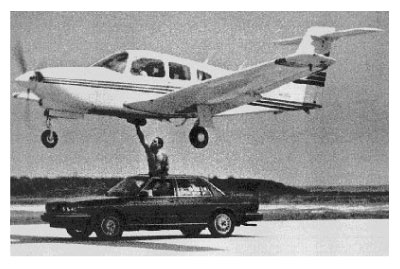
Five tips for describing pictures in an ICAO English test
1. Keep it simple Try to avoid complicated expressions or grammatical structures if you are not sure how to use them. Don't waffle (speak unnecessarily about a topic), and if you have nothing to say it's better to wait for the assessor to prompt you.
2. Ask the assessor for an explanation if you don't understand the task If you don't understand what you are supposed to do, ask the assessor to explain. For example, you could say:
- Could you repeat the question, please?
- I'm sorry, could you explain what the word .... means ?
- Could you please ask the question in another way?
3. Use full sentences Avoid answers which are single words or answers that sound like a list of bullet points. Demonstrate that you know how to form sentences correctly and can use a range of structures to express yourself.
4. Be aware of the time limits When you are asked to describe a photo and explain why something has happened, make sure that you leave some time for explaining your own opinion if that is a required part of the task. You should also avoid rushing, as speaking slowly and clearly is an essential skill in aeronautical communications. You will have better pronunciation if you slow down and don't swallow your words.
5. Get feedback Before an ICAO English test, get expert advice from Aviation English Asia Ltd. If you only practice with friends in a study group, you might copy their mistakes, and you will not be aware of your actual difficulties or proficiency. Remember, it's not what you say to answer a question, it's a matter of how well you answer a question. Students at Aviation English Asia are a friendly bunch who really make the effort to help each other. Of course, all our English courses for ICAO compliance offer thorough practice of these skills in each unit.
What to do next
For feedback and more information about Aviation English Asia’s courses please visit http://aviationenglish.com. We can help you improve your English whether you are an experienced pilot, a cadet entry pilot, a controller, engineer or flight attendant, with custom courses designed specifically for your needs. If you haven’t already please join the Aviation English mailing list for special offers and details of courses in your area.
- Details
- Written by: Michael
- Parent Category: Learning Zone
- Category: Learning Advice
English learning advice from Aviation English Asia. Article written by Michael Egerton
In a previous article, Describing pictures in ICAO Aviation English tests we learned some techniques to describe pictures. One of the lexical sets we said was necessary was vocabulary to describe an aircraft. In this article we will focus on how to describe the physical structure of a fixed wing aircraft, and also cover some grammatical structures you can use to relate the information. Of course many pilots will already be familiar with these words but it is worth ensuring that you can use the words with correct grammar, eg prepositions.
Most aircraft have the following major components.
- fuselage
- wings
- empennage
- landing gear
- power plant
Describing the fuselage and substructure
The fuselage is the central structure of an aircraft and includes the cabin, cockpit and area for storing cargo. When describing the fuselage also consider the materials it is made of, and how it is constructed. You should also know the following vocabulary:
truss, longeron, members, tubing, cross-brace, monococque, aluminium, skin, formers, bulkheads, airframe
Structure: You can also use the following verbs to describe the fuselage. Be aware of the form of the verb eg feature / features, and also if there are any necessary prepositions that go with the verb.
- The truss-type fuselage is constructed of steel or aluminum tubing.
- The Warren truss features longerons, as well as diagonal and vertical web members
- Small airplanes generally utilize aluminum alloy tubing
- A monocoque design uses stressed skin to support almost all imposed loads
- The monocoque construction mainly consists of the skin, formers, and bulkheads.
- The substructure reinforces the stressed skin by taking some of the bending stress from the fuselage.
- On single-engine aircraft, the engine is usually attached to the front of the fuselage
- A firewall is made of heat-resistant material such as stainless steel.
Describing the wings

Wings are attached at either the top, middle, or lower part of the fuselage and are referred to as high-wing, mid-wing or low-wing.
You should know the following vocabulary:
bi-plane, mono-plane, external braces / wing struts, cantilever, semi-cantilever, spar, ribs, aileron, stringers, ailerons, wing flaps, trusses, I-beams, leading edge, trailing edge, fuel tanks, faring, airfoil/aerofoil, flush, port, starboard, inboard, outboard
Structure: In addition to being able to identify the above parts of an aircraft, you should be able to describe it's function. You can use the following structures:
- wing struts transmit the flight and landing loads through the struts to the main fuselage structure
- wing ribs determine the shape and thickness of the wing
- ailerons create aerodynamic forces that cause the aircraft to roll
- flaps are used to increase the lifting force of the wing for takeoff and landing
- The flaps are normally flush with the wing´s surface during cruising flight
Describing the tail-section (empennage)
The empennage includes the entire tail section, consisting of the vertical and horizontal stabiliser. Basic vocabulary to describe the tail section includes:
rudder, elevator, stabilator, trim tabs, antiservo , tail fin, inclining, forward swept/sweeping, livery, vertical, horizontal, leading edge, trailing edge,
Exercise: Describe the following picture using 5 of the words above.

Describing the landing gear
Aircraft can have different types of landing gear eg wheels, skis or floats depending on whether the aircraft is used on land, water or snow. When describing landing gear consider what that particular type of landing gear is designed for. Essential vocabulary includes:
nose wheel, tail wheel, tyres, tricycle, floats, skis, undercarriage, fixed gear, retractable, extending, wheel well, shock absorbers, pontoons, skid, conventional "taildragger", tail strike, skid, tail bumper, spats, axle, wheel assembly, tracks, pivoting, steering,
Exercise: Describe the following pictures using 5 of the words listed above.

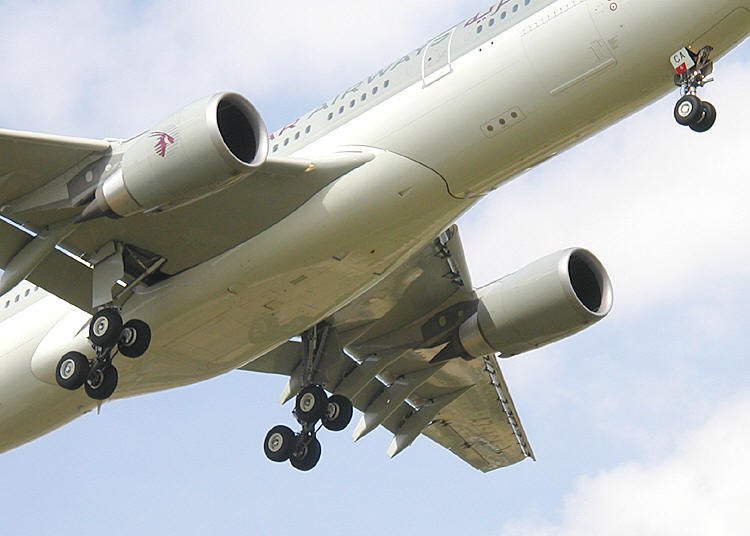
Advice for describing aircraft in ICAO English tests
There is a lot of vocabulary listed in this article, some of which you may already be familiar with - but learning English is not just a matter of remembering vocabulary. In order to communicate effectively in English you must be able to use vocabulary with reasonably accurate grammar. Try to create sentences using the structures presented above, or compare pictures of different types of aircraft. There are a lot of interesting pictures on websites such as airliners.net that you can practice describing.
What to do next For feedback and more information about Aviation English Asia’s courses please visit http://aviationenglish.com. We can help you improve your English whether you are an experienced pilot, a cadet entry pilot, a controller, aerospace engineer or flight attendant, with custom courses designed specifically for your needs. If you haven’t already please join the Aviation English mailing list for special offers and details of courses in your area. Of course, feel free to leave a comment or even a suggestion for a future article. We value all of your feedback.
- Details
- Written by: Michael
- Parent Category: Learning Zone
- Category: Learning Advice
Advice for improving your English and passing an airline's English test from Aviation English Asia. Article written by Michael Egerton
Prepare for an airline interview or prepare for your career?
Whether you are applying for a job as a pilot, member of ground staff or a member of cabin crew one of the assessments in which you are required to perform well in is the airline's English assessment test. For prospective airline pilots this is likely to be one of various types of ICAO English test taken at a particular stage of the selection process. For cabin crew and ground staff the airline is likely to have it's own in-house English assessment, which could be either a specific test which you need to pass in order to proceed which your application, or alternatively your English language proficiency could be assessed during your HR interviews.
In this article I'm going to point out three common mistakes made by many prospective pilots and flight attendants when faced with an airline English proficiency test, and show you how you can avoid making that mistake. But first of all let's look at why airlines have English tests in the first place.

Why do airlines have English proficiency tests as part of their selection process?
Airline careers are highly desirable for many young people. Airlines are large organisations that offer great benefits like housing allowance, health insurance and frequent travel to their employees. Some airlines are national flag carriers so it's not surprising that airline jobs attract thousands of candidates each year. In each recruitment drive, the airline has to select the most appropriate candidates for employment, as they will make a significant investment in that candidate's training and development. Airline English tests are a suitable way to filter out unsuitable (or not yet suitable) candidates. English is a world language, and a high standard of English will also highlight a candidate's manners and social behaviour, ie is this candidate a person polite enough to deal with our customers, is this a person we would like to sit next to on the flight deck. In addition to the aptitude and ability to perform the basic duties of the position, the airline will want to ensure that you have:
- sufficient language proficiency to meet the requirements of the job.
- sufficient potential to successfully be trained for the things that you don't yet know how to do.
So, in plain English, the airline wants to know that you can speak English well enough to do the job properly, and you can understand enough English to be able to learn how to do the things that you can't. Depending upon your experience and the position you are applying for the airline will probably not expect you to know everything about handling a big jet, or the procedures needed to carry out an evacuation but they do expect you to have a reasonable level of English. Airlines are after all, judged on the conduct and performance of their front-line employees. If you have failed an airline's English test it's probably because you haven't prepared sufficiently for the test, or you have prepared for the test in the wrong way.
The biggest mistakes made by candidates in preparing for airline English tests
Mistake number one - focusing only on the test
It's a common mistake, and an understandable one. You have an English test coming up as part of your interview and you might want to get some practice by having a mock test, perhaps by asking a friend to ask you the questions that they were asked last time. Perhaps if you could remember the answers it will be easier... If (like us) you live in Hong Kong you will have been bombarded by advertisements for "star tutors" that offer courses focused on passing English tests, eg IELTS, HKCEE etc. You might be able to pass a written exam by following their methods but if you think that you can pass an airline English test, which will almost certainly be oral you are wildly mistaken. Speaking English doesn't work like that. It takes time to develop a full command of the language, and consistent practice in developing the strength needed to pronounce certain words. Listening to and understanding different accents is a skill that takes time to develop. Furthermore, it's easy to see if someone is trying to remember an answer. When assessing language it's not just a matter of what information you give, but how you give it. Of course, it's natural to want to practice things like mock interviews with friends or perhaps a tutor, but to be honest it's not enough. What you need is a thorough and wide range of proficiency in English and particularly English as it is used within an aviation context - and that is our goal.
Mistake number two - doing the wrong type of course
ICAO recommend that pilots and controllers take aviation-specific English courses. Some people try to cut corners and settle for a general English course. The result is often that they get bored or find that it doesn't suit their needs. This is also often the case with people who tried studying at large franchised language centres, particularly those that have "secret study methods". These courses are designed to appeal to as many people as possible, with the lowest skill level of teacher possible (the "secret" is that they withhold any actual teaching, you have to figure it out for yourself) so don't be surprised that learners who settle for this type of course make very slow progress. That type of language school doesn't have the capability or resources to give aviation students the kind of language training they need. When you learn English it is important that you focus on practicing the right skills, and as most language schools try to cater to as many people as possible it's often difficult to practice the skills that you really need. For a pilot, ATC or member of cabin crew the most important skills are speaking and listening. Many people unfortunately focus only on academic performance in English and neglect to build their English comprehension skills. Aviation English Asia courses give you sufficient practice of the skills that you need, as recommended in ICAO Document 9835.
Mistake number three - not starting a course early enough
If we could give one piece of advice to potential airline employees it would be to take a placement test to assess your current level of English and then see how much you need to improve. We can then give you an estimation of how long you should expect before you reach that level, and how often you should practice. These tests are done independently by a third party so you can be sure that you won't be buying courses that you don't need. The placement tests offered by Aviation English Asia are consistent with the results of assessors within major airlines. Trust me - I've trained a lot of prospective and current airline employees. I strongly recommend that you take a placement test and expect to practice English consistently for at least 3 months per level.
The BEST WAY to prepare for an airline English test
In this article you have learned that you should avoid crash courses, avoid only focusing on the test, and avoid unsuitable courses and tutors. Now I will show you what you should do to pass an airline's English assessment.
Learn and practice English as it is used in the context of aviation
Aviation English Asia is the only genuine provider of Aviation English in Hong Kong. Our Native English Teachers are aviation professionals with experience as senior captains, air traffic controllers and aircraft maintenance engineers. Our Native English Teachers are also qualified English teachers - not just "English speaking pilots doing a part time job". The course is designed and supervised by teachers with MA Applied Linguistics. Some of our teachers have worked as and trained assessors.
AEA courses feature all of the grammar, vocabulary, pronunciation, comprehension and fluency practice of general English courses, with the added advantage of being directly related to your career. You will be more motivated and enjoy learning English more when you have a clear objective. If you think you know everything about aviation and are familiar with aviation terminology, you should still learn how to express it clearly in English - so Aviation English Asia courses are equally suitable for experienced commercial pilots. It's exactly the same for cabin crew, whether your are a prospective employee or experienced crew members - practice English as it relates to your everyday life. One of the biggest advantages of an Aviation English course is that you will develop a wide vocabulary and become confident in dealing with unexpected situations. You will still get thorough practice of all the language skills needed to pass an airline's English test, and personal focus on the skills that you most need to develop. Of course, you can supplement this with additional General English if you want extra practice but it is no substitute for a core Aviation English course.
What to do next
For feedback and more information about Aviation English Asia’s courses please visit http://aviationenglish.com. We can help you improve your English whether you are an experienced pilot, a cadet entry pilot, a controller, aerospace engineer or flight attendant, with custom courses designed specifically for your needs.
If you haven’t already please join the Aviation English mailing list for special offers and details of courses in your area. Of course, feel free to leave a comment or even a suggestion for a future article. We value all of your feedback.
- Details
- Written by: Michael
- Parent Category: Learning Zone
- Category: Learning Advice
Advice about improving your English and passing an ICAO English test from Aviation English Asia.
Article written by Michael Egerton
Reason One: Not realising the importance of English in aviation
Reason Two: Not giving yourself sufficient time to prepare for an ICAO test
Learning English takes time and the more time you allow for yourself the more likely you are to perform well in the test. Cramming might work for preparing for an exam that tests knowledge but learning a language is different. You need time to internalise the language, pronunciation is a muscular skill that takes time to develop. There are some academic theories supporting intensive courses but in my experience intensive courses are only beneficial to those at a very early or very advanced stage. If you are at an intermediate level of English I recommend that you take your time over a course. You will probably enjoy learning English more if you don't have time pressure.Reason Three: Doing the wrong type of English course
This is quite tragic as we have heard stories about people who have enrolled on 18 month courses (paid in advance) with brand name English schools who fail to improve at all. It's even more tragic as their English often gets worse because of the environment they learn in. If you are serious about an aviation career you need Aviation English. Other types of courses and coffee shop English tutors might be cheaper but they will ultimately waste your time and money because they do not effectively address your needs. General English has its place in Aviation English - it's an essential part but should be practiced within a meaningful context. This is true whether you are a commercial pilot or ab initio. And when you have the exciting world of aviation, where there are developments and dramas every day, why would you waste time on anything else?Reason Four: Teachers using inappropriate learning materials
Creating authentic Aviation English learning materials takes a lot of time, specialist knowledge and skill from the Aviation English teacher. There are very few Aviation English learning materials available commercially so Aviation English teachers need to hand craft them to suit your needs. General English course books are designed to appeal to as many people as possible and then mass produced and shipped all over the world. They serve a purpose in that they make General English teachers' lives easier because they can recycle the lessons with many different students - putting the teacher's comfort ahead of your learning needs. Regardless of whether you are in ground school or an experienced pilot you should be using English that is relevant to your life and an experienced Aviation English teacher will be able to create interesting lessons that allow for sufficient practice of that type of language.Reason Five: Starting an English course at the wrong level
As pilots you may feel pressure to keep up with your colleagues who might have had different experiences in learning English. The truth is that you won't lose face by starting at a lower level - just accept that you have had different experiences and have different strengths, English proficiency being one of them. So, if you take a Placement Test and find that you are at a lower level than your friends or colleagues don't feel any shame in starting a course at a lower level. Similarly if you have a higher ability than your colleagues you shouldn't hold yourself back - the result of starting a course at the wrong level is that you will find it too easy and get bored, or find it too difficult and get frustrated - then lose motivation. Also be aware that franchised schools often try to sell courses that are longer than you really need. Even worse is when a school gives you a ten minute computer placement test and then tells you your starting level without any assessment from a native English teacher. Instead a consultant who knows nothing about learning English (or how to speak it) tells you your starting level and then how to improve. It's the blind leading the blind. Usually the student finds a course difficult and struggles consistently and the teacher doesn't have the heart to tell them that they are at the wrong level, so the student quickly loses motivation.Get it right: How to perform well in an ICAO Aviation English Test
Motivation is a very important factor in learning English. The genre of aviation is also incredibly motivating for most people so don't let your passion be affected by making one of the mistakes listed above. Aviation English Asia teachers are skilled in ensuring that learners are keen, motivated and developing good study habits. Take advantage of our enthusiasm and arrange a free consultation. We'll introduce you to an effective course and study plan that is right for you.Contact Us Today
Hong Kong
Aviation English Asia has been offering part time and full time courses in Hong Kong since 2009.
All courses are available in Hong Kong. Check the schedule above for details.
Vietnam
Aviation English Asia has been offering part time courses in Vietnam since 2014.
All courses are available in Vietnam - typically every 8 weeks, or by special arrangement.
Taiwan
ICAO Aviation English, English for Aircraft Maintenance Engineers, Technicians and Mechanics, and English for Flight Attendants are available in Taipei, Tainan and Kaosiung.